Luck, Solved
People burn absurd amounts of energy arguing over whether success comes down to luck or skill. It’s the wrong fight. Luck comes in three flavors, and two of them you can actually learn to create more of.
The first is the luck you’re born with. Warren Buffett calls it winning the ovarian lottery, and it’s the kind everyone fixates on, but it’s also the kind you have the least ability to interpret correctly. There’s an old Chinese fable about a farmer and a horse that shows why. Good luck, bad luck, who knows?
Then there’s the interesting part. Why do some people walk into the same room and spot the opportunity everyone else misses? Richard Wiseman spent a decade studying that question, and it turns out lucky people share four specific habits. None of them are mystical, and all of them can be learned.
We also get into why your brain quietly edits the luck out of your own story, and what that costs you every time you make a decision. Why the smartest move in almost any situation is to assume you’re lucky, even when you’ve been dealt a terrible hand. And poker champion Annie Duke on the trap that wrecks most people’s thinking: mistaking a good outcome for a good decision.
Once you can actually see the forces shaping your life, luck stops feeling like a guilt trip and starts feeling like something you can work with. Turns out you can make yourself luckier. Even you.
Episode Notes
Referenced in This Episode
- Join the 21 million people who’ve started Simple already. Go take the quiz and use the code SOLVED at checkout for 85% off your plan.
- Always say hello with QUO. Try QUO for free PLUS get 20% off your first 6 months
- Start eating better with 50% off Factor Meals
- Stop waiting for permission to build something. Start free with Shopify
- Napoleon Bonaparte
- Richard Wiseman (luck researcher, University of Hertfordshire studies)
- San Cai framework (Heaven, Earth, Human luck - Chinese philosophy)
- Boethius, The Consolation of Philosophy (Wheel of Fortune)
- Niccolò Machiavelli (fortune as a raging river, The Prince)
- Annie Duke, Thinking in Bets: Making Smarter Decisions When You Don't Have All the Facts
- Annie Duke, Quit: The Power of Knowing When to Walk Away
- Warren Buffett
- Morgan Housel, The Psychology of Money
- John Rawls, veil of ignorance (A Theory of Justice)
- The Farmer and the Horse (Chinese fable, Sai Weng Shi Ma)
- Just World Hypothesis
- Actor-observer bias
- Hindsight bias
- Self-serving bias
- Andrew Roberts, Napoleon: A Life (biography)
- Attentional Control Theory (Eysenck et al.)
- Malcolm Gladwell, Outliers (computing revolution timing/Bill Gates)
- Bill Gates
- Steve Jobs
- Mark Zuckerberg / Facebook founding
- Sam Altman, CEO of OpenAI
- Dario Amodei, CEO of Anthropic
- Daniel Kahneman, prospect theory / Nobel Prize in Economics
- Amos Tversky
- Loss aversion
- Chris Moneymaker, 2003 World Series of Poker
- Alex Hormozi (\volume negates luck\")"""
- Philip Tetlock
- Barbara Mellers
- Philip Tetlock and Dan Gardner, Superforecasting: The Art and Science of Prediction
- Alliance for Decision Education (nonprofit co-founded by Annie Duke)
- Seneca, negative visualization / premeditatio malorum
- Purpose app (AI coaching app co-founded by Mark Manson)
Prefer to read this episode?
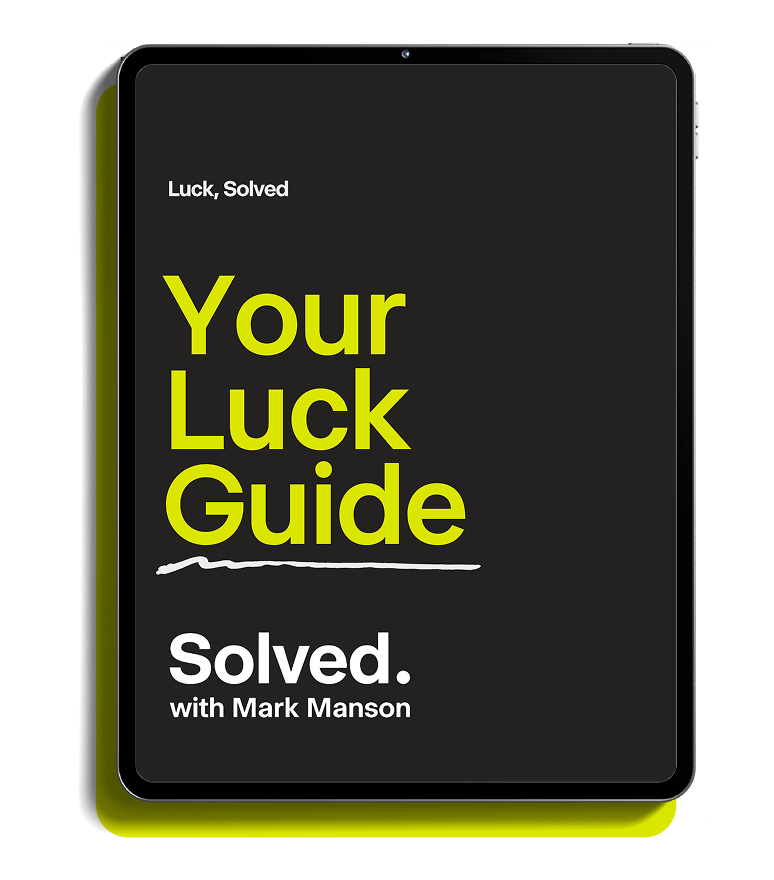
Well, you’re in luck. I made you a handy digital reference guide with the sharp recaps you need—because let’s be real, you’ll forget half of this by tomorrow.
It’s free. Just join the podcast mailing list, and I’ll send it over. No spam, no fluff—just the stuff that actually helps.
Hit the button. Get the goods.
Your information is protected and I never spam, ever. You can view my privacy policy here.